How to Identify aSanderling
Calidris alba · 7.1–7.9 in (18–20 cm)
Male vs. female
Male
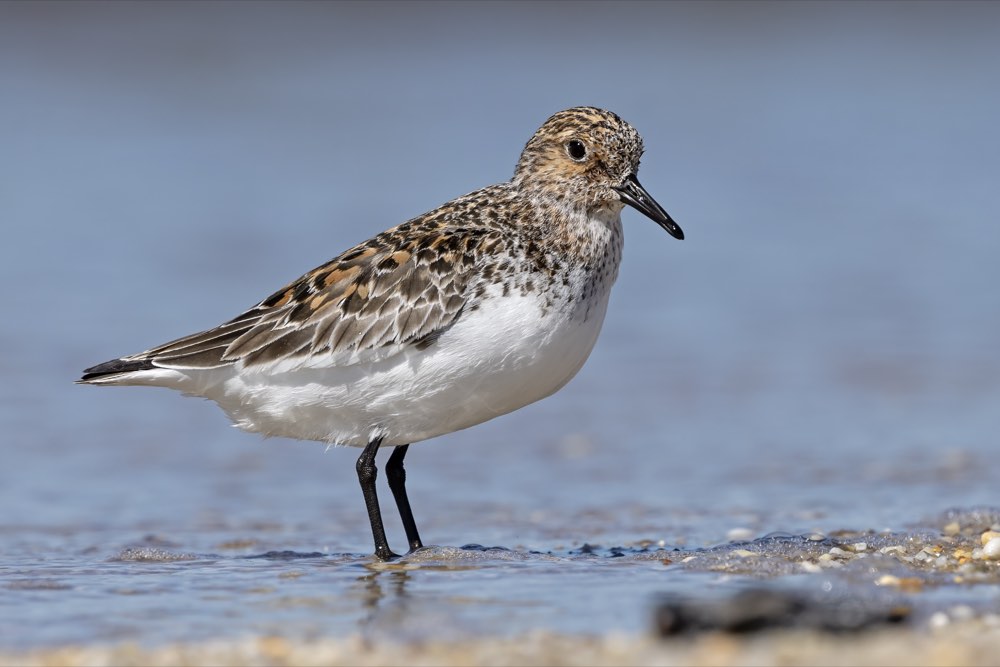
Very pale gray above and white below in winter, with a black bill, black legs and a dark shoulder mark. Sexes look alike.
Female
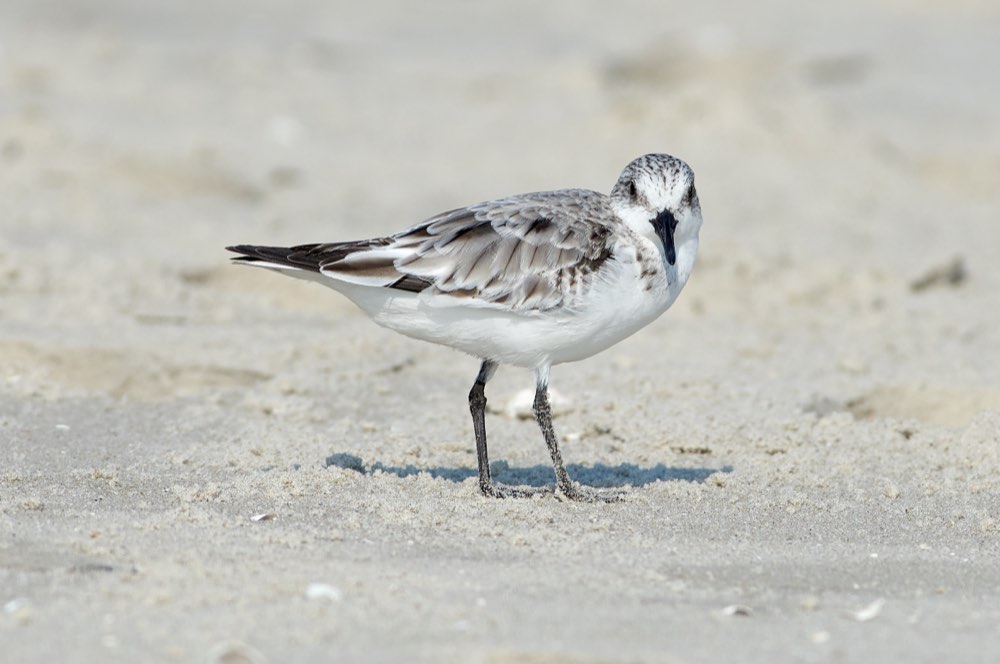
Identical to the male in the field.
Male photo: Chuck Homler, Focus On Wildlife / Wikimedia, CC BY-SA 4.0 · Second photo: Hobbyfotowiki / Wikimedia, CC0
Field marks
- Palest of the small sandpipers in winter
- Black bill and black legs
- Bold white wing stripe in flight
- Runs on twinkling legs at the edge of the surf
Similar species
What it sounds like
A sharp, hard "kip" or "twick", often given in flight.
Behaviour that gives it away
Runs in and out with each wave to grab prey exposed by the backwash, a rhythm no other beach sandpiper follows so closely.
Habitat & range
Open sandy ocean beaches, and sometimes lakeshores on migration.
When you'll see it
Depending on where in eastern, western and southeastern North America you are, it is a winter visitor and a passage migrant, seen mainly in spring and autumn.
What it eats
Small crustaceans, molluscs and marine worms uncovered by waves.
Did you know?
It lacks a hind toe, which is unusual among sandpipers and may help it sprint across wet sand.
Spot one yourself?
Point your camera at any bird and Aviarist identifies it in seconds — then logs it to your life list.
Get Aviarist on Google Play
More backyard birds
_in_Breeding_Plumage_in_the_Delaware_Bay_-_Heislerville_WMA_-_Cumberland_County_-_New_Jersey_-_May_2026.jpg)
.jpg,_Amrum.jpg)
Other apps we make