How to Identify aHooded Oriole
Icterus cucullatus · 7.1–7.9 in (18–20 cm)
Male vs. female
Male
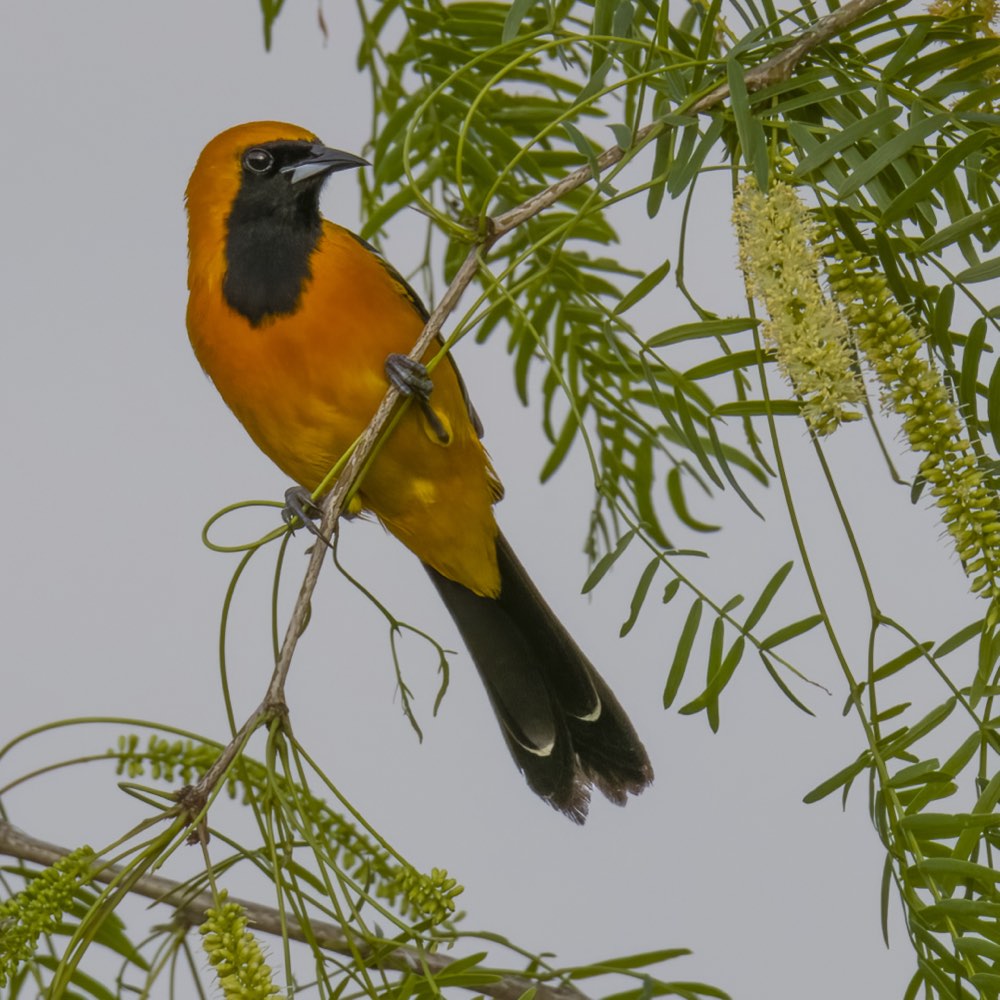
Rich orange-yellow with a black face and throat, black back, wings and tail, and two white wingbars.
Female
Olive-yellow overall with grayish wings and two white wingbars, and no black.
Male photo: lwolfartist / Wikimedia, CC BY 2.0
Field marks
- Long, slim, distinctly downcurved bill
- Black throat patch running up onto the face
- Slim body and long tail
- Strongly associated with palms
Similar species
What it sounds like
A quick series of whistles, chatters and warbles, often including imitations of other birds.
Behaviour that gives it away
Stitches its hanging nest to the underside of a palm frond, sewing the fibres through the leaf.
Habitat & range
Palm trees, riverside woods, gardens and suburbs across the Southwest and California.
When you'll see it
A summer visitor that arrives to breed in southwestern and western North America.
What it eats
Insects, nectar and fruit; regular at hummingbird and jelly feeders.
Did you know?
It sews its nest directly onto the underside of a palm frond, stitching plant fibres through the leaf itself.
Spot one yourself?
Point your camera at any bird and Aviarist identifies it in seconds — then logs it to your life list.
Get Aviarist on Google Play
More backyard birds

Other apps we make