How to Identify aAmerican Avocet
Recurvirostra americana · 16.9–18.5 in (43–47 cm)
Male vs. female
Male
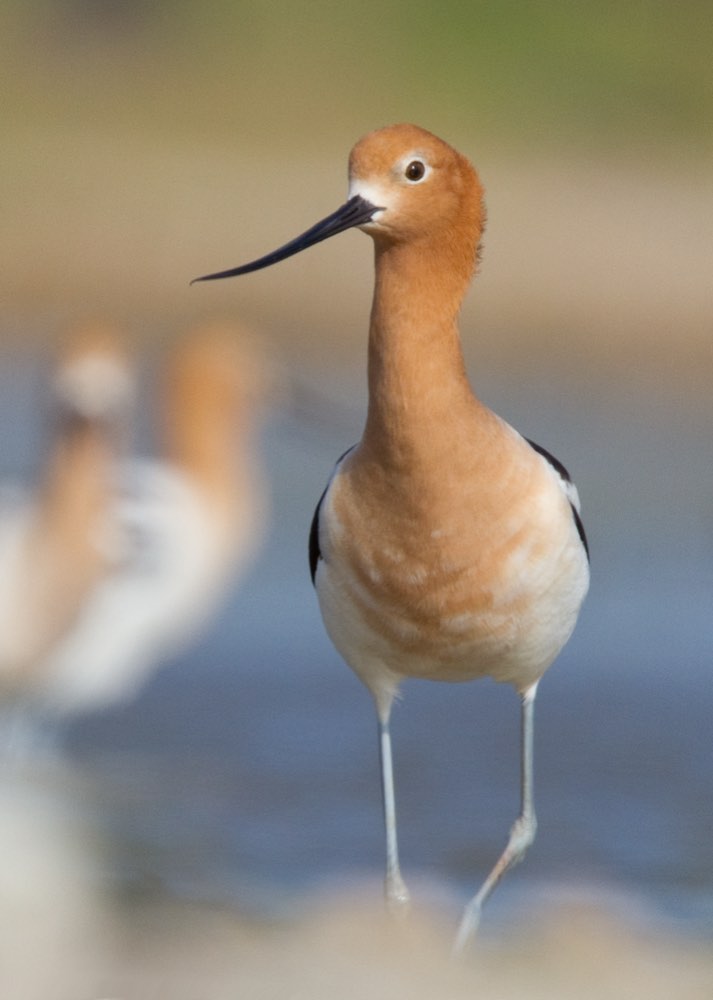
Bold black-and-white above, white below, with a rusty-orange head and neck in summer and a gently upcurved bill.
Female

Like the male but with a shorter, more sharply curved bill.
Male photo: Dan Pancamo / Wikimedia, CC BY-SA 2.0 · Second photo: Mike Baird from Morro Bay, USA / Wikimedia, CC BY 2.0
Field marks
- Thin bill curving distinctly upward
- Bold black-and-white wing pattern
- Long blue-gray legs
- Rusty-orange head and neck in breeding season
Similar species
What it sounds like
A sharp, repeated, rising "wheet wheet wheet", growing frantic near a nest.
Behaviour that gives it away
Feeds by sweeping its upturned bill side to side through shallow water, filtering out tiny animals by touch.
Habitat & range
Shallow alkaline lakes, salt ponds, flooded fields and coastal lagoons in the West.
When you'll see it
Depending on where in western, central and southwestern North America you are, it is a summer visitor that arrives to breed and a passage migrant, seen mainly in spring and autumn.
What it eats
Aquatic invertebrates and small crustaceans swept from shallow water.
Did you know?
The upward curve of the bill is what makes its sideways scything action work, sweeping a wide arc through soft mud.
Spot one yourself?
Point your camera at any bird and Aviarist identifies it in seconds — then logs it to your life list.
Get Aviarist on Google Play
More backyard birds


Other apps we make